“I see that you don’t listen to the Pope either!” This was the teller in the Bank of Montreal in Toronto, where I was living then. She touched her own St Christopher medal, and pointed to the one I wore. Just a few years before Pope Paul VI had removed ninety-three saints from the canon, the saint of travelers among them. That did not end my fascination with the saints or their stories.
|
|
The Provence is a region that abounded in early Christian saints. It is now long ago that I first went to the Camping La Vallée Heureuse, at the foot of the cliff that holds Notre Dame de Beauregard. Such chapels were my landmarks, as I tried to find out more about the history of those saints, who Christianized this pagan countryside. |

Almost every village there seems to have had a local saint, and I am always hearing about more. Quite recently, driving near Tarascon, my sister in law Pascale told me of how Saint Martha tamed a local monster, the tarasque. The beast’s ending was sad, though, for the villagers, not trusting in a permanent soothing of the savage breast, killed it nevertheless.
The stories are often fanciful. After all, they belong to many centuries of folklore. When I would follow them up in The Golden Legend or other hagiographies, the stories would branch, mingle, blend, and conflict. But for myself, I keep fast to the stories that beguiled me.
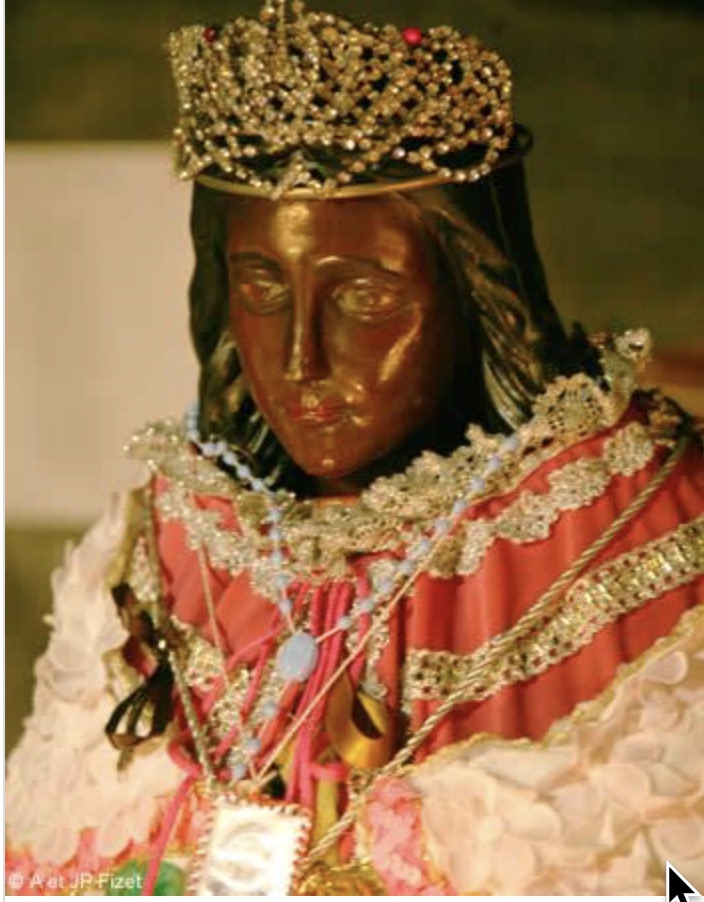 Today Saint Sara the Egyptian is worshiped by the Roma, annually at Saintes-Maries-de-la-Mer, and they carry her statue into the sea. The Bishop comes to give his blessing although, just as in the case of St. Christopher, the Church does not recognize her as a saint.
The story I heard is not one of those told at this feast, but it is the one I love.
In the first century of our era Sara, a black woman from Egypt, was a serving maid in a Christian household in Jerusalem. This was during the years just after the crucifixion, a time of persecutions. The entire family, their servants, and some other Christians — as it is now told, the three Maries of the Gospels — escaped on a boat. The Mediterranean was stormy, so stormy in fact that when the tempest was over, the ship was adrift without sails or rudder. Happily a coast was in view; it was the coast of the Camargue, west of what is now Marseille.
How to reach it? They prayed for a miracle, but no miracle happened. The boat drifted aimlessly. Fishermen came out in little boats, and offered to tow them for a fee. But all ballast, including all that was valuable, had been thrown overboard during the tempest, to lighten the boat.
The fishermen were adamant.
Then Sara, who was very beautiful, offered a payment, and the fishermen accepted. Sara stood on the prow and slowly disrobed, a saintly strip tease, for the duration of the towing. That is how the Christians were saved, and how the Camargue was first evangelized.
The Church and historical fact aside, Saint Sara is a real saint. Later, traveling east into northern Italy, I learned of a woman who is not a saint but might well have been. This the story of the Beautiful Ada.
 I heard about her when visiting the Abbey of San Michele near Torino. The care-taker monk told me the legend. It happened in a time of war, but there were so many wars, skirmishes, raids, sieges. Ruins of forts and castles are strewn everywhere across this region. Ada was a young woman in a village near the Abbey. When the soldiers came all the villagers rushed to the Abbey for shelter, but the enemy was on their heels. Pursued by the mercenaries, Ada fled to the top of the monastery’s outer tower. She heard the soldiers’ boots on the stairs behind her, there was nowhere to go. Commanding her life to the care of San Michele, she leaped off. There was a miracle. Miraculously unhurt, she escaped to safety.
But during the Feast of San Michele a year later, she leaped off again, on a wager, and it broke every bone in her body.
The Beautiful Ada might have been a saint, if not for one foolish moment later in life.
 Bas van Fraassen's Commonplace Book