Long before I came to California I was aware of it as a center of spiritual life in many forms.
When we had landed in Edmonton in 1956, our first house was on 92nd Street, near the disreputable part of downtown. I had my bed in the attic. There, in a closet, I found a stack of Reader’s Digests and many pamphlets, little booklets, published by the Vedanta Society of California. These pamphlets had appealing photos of a monastery near San Diego, with secluded gardens for meditation, and of two women of amazon stature  , glowing with health and good will, in white togas.
In these pamphlets I read about Swami Prabhavananda, who had come to California from India, to bring the message of the saint Ramakrishna, and the teachings of the Vedanta. I got a paperback copy of the Bhagavad Gita and of the Upanishads (I still have it!) and daydreamed of a retreat into the beautiful arms of a monastic life.
Many years later, living in Berkeley, I happened to pass by the Vedanta center there. I did not stop, there had been too many detours and byways since then, although I was, and am, still fond of the Bhagavad Gita.
Living in, rather than visiting, California became possible in the mid seventies, when I started teaching spring semesters in Los Angeles. Living in Venice, near the sea, I found the Temple of Man, a poetry center sustained by a permanent daily garage sale. Having declared itself legally as a church it was tax exempt, and a garage sale needs no business license, nor are there rules for how often you can have one. The poetry evenings were memorable for the poets. One was a very manly man whose poem was about being a poet and ended with the line “A work worthy of a man!“, to which I heard many murmurs of assent. The woman who followed him talked about her own poetry before reading it, and indicated in a not so veiled way that she had once slept with Allen Ginsberg, back in the fifties.
Still searching I looked into the telephone yellow pages and found, with surprise, that in the nearby St. Monica Catholic Church a Latin mass was celebrated each Sunday. Latin! Vatican II, which had turned the altars around and prescribed the liturgy to be in the language of the country, had happened more than a decade before. But some churches kept a place for the old ritual and its solemn dignity.
The church was large, full of people in shorts and short sleeved shirts or low cut blouses, perhaps to be expected with the beach and Santa Monica pier so nearby. 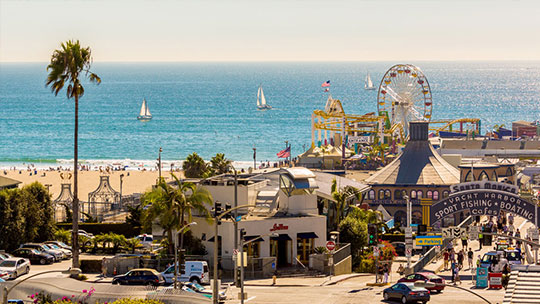 The mass was celebrated by two priests, one young and one old. The young priest spoke Latin with such ease that he seemed to be talking with God as with a friendly neighbor (“hello God, it’s me, Damian …”, something like that) . The old priest was, in contrast, stumbling so much over the Latin, and so tardy, that the occasional coughing was growing slowly into a small epidemic. I was not Catholic, and not focused enough to overcome these barriers. I had hoped for something to intrigue me, that was not there.
The next year I returned, and first walked by the Temple of Man. The younger of its two attendant men, Thomas, was there managing the garage sale, and invited me over to his house. We went to the upper floor, dark with curtains on the windows, light subdued … A couple of very young people were there, a little dreamy, or perhaps sleepy. One began to play the flute as we drank tea. Thomas began to talk about how they were no longer happy in the Temple of Man, and invited me to come by again on the weekend. I did go back once or twice, feeling a bit lonely just then. But the atmosphere felt awry, sometimes even a little sinister. Soon I decided to leave it alone.
I had seen a notice tacked up in the house, announcing the Los Angeles Zen Center’s introductory meditation classes. 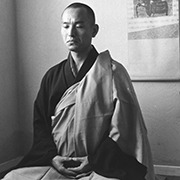 So I started going on Tuesday evenings. An apprentice monk would be in charge, give a little talk about breathing, counting our breaths up to 13, letting thoughts go their own way, as if they were birds flying by. Then we would sit. At first everything inside me was screaming to get out. After some weeks I had progressed to ten minutes of peace, before feeling as if a huge rock inside me wanted to roll out. At the end of twenty minutes we would have tea, and some desultory talking.
At the end of the semester, we were told, it would be possible to have a private interview with an adept, possibly the abbot. The ritual for an interview was very clearly defined. The supplicant would sit outside the door and wait for a tinkling bell, then enter on his knees to kneel before the master. There was to be no speech unless the master asked. To signal the end, the master would ring the little bell again. Then, immediately, the supplicant must exit, going backward, on his knees.
As we talked, we learned a little about each other. One young woman said that she had a recording of Eastern music to meditate by. She would recline when centering her attention, often find that she had peacefully fallen asleep. A youngish man who was always very restless began to talk. He had grown up in a mobile home, his bed was in an alcove that he could close off from the family. Every word he uttered sounded like a hurt, a voiced distress, a pained memory.
The next time, when he spoke again, there was a silence when he ended. Then the apprentice monk began to speak. When I first came here, he said, I had a great deal of pain. I had lost my way, I could not bear what I was going through, I had come to escape myself. After a month or so I was granted an interview with a master visiting us from Japan. I was in awe of him, a man of such solidity, this was a man like a wall. I waited at the entrance for the little bell, then went in. Kneeling before the master I waited. He looked at me with compassion. I felt that here, finally, there was someone who could understand me. Gently he said “You have much pain.” He paused. Then: “Get rid of it!” Tinkle, tinkle, tinkle …
Did I also have an interview with an adept at the end? Yes, but there was nothing to remember, not even a summary dismissal. It was a time when, as I now know, I was blithe, blithely turned away in my ignorance, looking outward only, not ready for anything they could have shown me. Could they have shown me anything? I don’t know, I still have my doubts. I did not return to the Zen Center the next year.
In 1981 I did not return to Los Angeles but started on my time in Princeton. The long story of how I drifted toward, and eventually into, the Church is for another time, if at all. But I want to end this with the nun, Sister Mary, who taught me the catechism. A woman well into her fifties I think, she belonged to a liberal order, very Vatican II, detested by the more orthodox parts of this always dysfunctional, yet stay-together, church. She took as her textbook the 500+ page long Dutch catechism, also infamous for its liberal form. Since I had not grown up Catholic, some very simple things were a mystery to me. Watching the sign of the cross made in quick and careless gestures confused me: what was first, the downstroke or the horizontal? It is easy to remember, Sister Mary said. You mention the spirit last, and the spirit has two wings.
When our lesson strayed into the personal she would not give advice, but solace: God writes straight on crooked lines.
At the end of the school year Sister Mary was re-assigned to a campus in New York. She was at once distressed and optimistic, visibly hopeful. Who knows, she said, it may be a new life. I may fall in love again! who knows what will be.
******
There was a song often played the first year I taught in Los Angeles. I only remember now the slowness of its melody, and a single line.
Time goes by so slowly …., and time can do so much ….
 Bas van Fraassen's Commonplace Book
Thank you for sharing this, I am very pleased to know about these events of your life.
LikeLike