The only philosophical novel about climbing I ever read was Kerouac’s Dharma Bums. The scramble up the Matterhorn in the Sierras is fabulous. Ray, the narrator, is enthusiastic, set on going to the top, but in fact becomes more and more terrified. “This is too high!” he yells to his friend Japhy, he can’t go on. He finds a small ledge at a level angle; shaking, he nudges his whole body into the rock to hold himself tight, and realizes he’s had it. He’s done for.
Later, as he watches his partner Japhy coming down from the summit, leaping like a mountain goat, Ray has a great insight: “Then suddenly everything was just like jazz: it happened in one insane second or so … and in that flash I realized it’s impossible to fall off a mountain, you fool”. Freed from his fear, he leaps, runs down, jumping from boulder to boulder after his friend.
To understand this it helps to be a little high. It all makes perfect sense after a toke or two. But isn’t it at the same time utterly realistic? Haven’t we all come to such moments of sheer terror? I certainly have. There are moments in Yosemite, on Middle Cathedral, on its East Buttress and on the Central Pillar of Frenzy, that come back to me in dreams, to wake me, still afraid. I’ll confess that to you, who know that those are moderate, safe climbs. My fear was, after all, not warranted — but so real ….
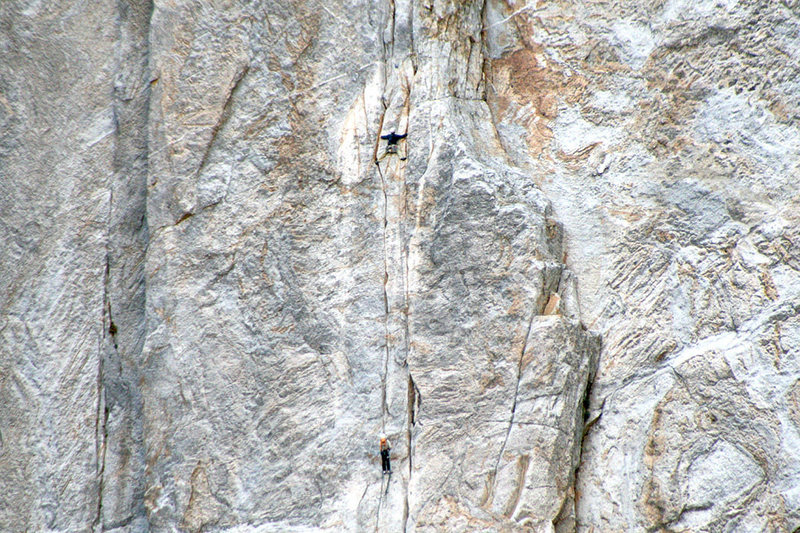
What then of Ray’s experience of coming out of the fear, the sudden freedom, a sense that now anything, anything is possible? Not everyone has experienced this hopelessness in a climbing situation, and not everyone has experienced its deliverance. Yet both can occur in any aspect of our lives, in a financial bind and no credit, in a skid on an icy road, in a relationship on the verge of breaking up — you must have your own, you, mon semblable, mon frère …. Even if in retrospect we were not in great danger at all, such situations present, I think, a perfect instance of Sartre’s view that emotions are key not only to cognitive self-hindrance, but to cognitive self-rescue as well.
When William James reflects on extreme choices, his guiding example is a climber late in the mountains, before a crevasse, with a seemingly impossible way forward and no way back. James urges the will to believe, to believe that he can make it. That’s all good, but James gives us no way to distinguish the climber’s leap — if he leaps! — from a purely irrational act, no better than an insanity. Surely, clearly, we wouldn’t call it madness at all. It is Jean-Paul Sartre who offers us a view which locates Ray’s deliverance, from this ‘no way out’ situation, as rational, even if not rational in any traditional sense.
Unlike Ray, I am an analytic philosopher. So, in any such situation I have to list my options, and for every option its probability and possible outcomes, each with its assigned value. Maximize expected utility! that is the rule.
Once I have done that, I look at the rock in distress: — not a single one of these options comes with an acceptable risk. Now what? I am stuck. My assessment cannot change unless what went into the calculation changes. But what went into the calculation were my probabilities and values, and you simply can’t use your probabilities and values to change your probabilities and values.
How could this way of decision making overcome itself? It can’t. The intellectual situation is as much an unsolvable problem as my dangerous physical situation.
But something happens to solve the impossible problem. It simply must! The factors that make for the decision situation themselves are changed. The options have changed because what was totally unlikely now looks likely enough, or what was unbearable comes to be seen as bearable.
Sartre identifies emotions by their function, and the main function is that of transforming a situation, from one of insurmountable difficulty, facing a decision with no acceptable options, into one where action is possible.
“It is a transformation of the world. When the paths traced out become too difficult, or when we see no path, we can no longer live in so urgent and difficult a world. All the ways are barred. However, we must act”, Sartre writes, and he describes what comes to be, “a new unreflective consciousness which now perceives the world otherwise and with a new aspect, and which requires a new behavior”. Emotion is not passivity, it is not a disturbance undergone, nor mere feeling. Emotions involve choice and idea and purpose. The world is transformed in our emotional experience and it is in this new, transformed world that we can act and live.
Most of the time I am sure that I have never been in danger of my life when climbing. So, most of the time, I think of those moments of sheer terror as like emotions experienced watching a play, in a theatre. But last year Steven Gubser died, in a 100 meter fall from L’Aiguille du Peigne, in Chamonix. Shortly after I began climbing in Yosemite, back East where I lived, Steven became my teacher in the Gunks, leading me up fabulous routes like High Exposure and Son of Easy O. These climbs eventually became my own favorites as well. I wonder, but I will never know, how Steven experienced the situation that led to his fall. But I can still see him as he looked up at the crux of Cascading Crystal Kaleidoscope, hesitating, bracing himself with the words “It’s a mind game, it’s just a mind game!”, and made himself go. I am lifting a glass to you, Steven, and I spill a single deliberate drop, in your memory.
Note. My friend Kimbrough Moore asked me to write a reflection, for a new climbing guide. This was it.
 Bas van Fraassen's Commonplace Book
Thank you, I’ve ordered the book, am looking forward to it.
Bas
LikeLike
Check out the novella “Ascent” by Ludwig Hohl.
LikeLike