
Sometime in the 1970s I was at a grand interdisciplinary conference in Florence, “Livelli di Realtà/Levels of Reality”. This was a cultural event, and the organizer, Massimo Piattelli Palmarini — who, as he said to me later, was a ‘great snob’ — had invited luminaries from philosophy, psychology, physics, sociology. Even literature, for Italo Calvino had agreed to speak.
From America he invited Stephen Jay Gould as well as philosophers Putnam and Goodman, from France the physicist Bernard d’Espagnat and the psychiatrist André Green, from Britain the philosopher Sir Alfred Ayer.
That was exciting for me. I had told my students to read Ayer, the razor-sharp critic who as a young man — some forty years ago — had brought Logical Positivism to Britain, arousing scandalized opposition. Well, as it turned out, we were going to witness him in full critical flight.
The conference was held in the Palazzo Vecchio, which is both the town hall and the cultural center of Florence. In a large hall we sat equipped with headphones, for there would be simultaneous translation into Italian, English, and French. There were several days of lectures, musical concerts, and a reception to be hosted by the mayor of Florence with the presence of Tuscany’s Minister of Culture. But I want to describe just one episode, featuring our philosophical hero, Sir Alfred Ayer.
On the second day there were perhaps the most people in attendance: the psychiatrist, André Green, was to speak on the Unconscious. You must imagine us in this great hall, all the walls hung with enormous tapestries depicting dramatic scenes from the Bible and mythology. Green was an imposing figure, and immediately drew our attention to one tapestry:
 “Here we see an undressed woman on the bed. A man, not overly dressed himself, is fleeing the bed in fright. Why?“
“Where do I, as a psychiatrist, look when I ask why?” He lowered his pointing finger dramatically. “Under the bed! Look closely, what do you see there?” In fact there was, barely visible, the head of a very small dog emerging from the hanging bed covers.
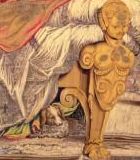 That little dog did not look very threatening or sinister to me, but we were quickly to see its significance, the dark forces lying just beneath the surfaces of the mind.
As soon as Green’s lecture had ended, Ayer stood to take the word. There was some rustling and whispering behind me. Ayer had taken off his jacket, standing in his shirt sleeves with the suspenders, that held up his trousers, saliently displayed.
“In fact this tapestry presents the story of Joseph and Potiphar’s wife who tried to seduce him. Why does Joseph flee? Well, let’s suppose it is a real event. First, Joseph sees the danger to his political ambitions, if he sleeps with his master’s wife. Second, perhaps he does not find the woman beautiful — though the painting seems to exclude that. And third, he might have religious scruples about adultery. At this point, why look below the bed?
Why, when we have at least three perfectly rational explanations, should we go looking at a tiny dog below the bed?”
André Green rose very slowly to address us (someone else had already begun an agitated retort), he rose to his full height, and when he spoke, the sarcasm was almost tangible.
“I will let you in on a secret. I do know the story of Joseph and Potiphar’s wife. But I thank Sir Alfred for making this so clear for all of us.”
The great reception was that evening, with music and the many fine wines of the region. It was quite late when I was back a the hotel. There, at the desk, I saw Ayer, obviously meaning to get his room key. It did not seem to be going well. Ayer was perhaps in a condition where communication seems totally clear and transparent, or at least, not in a condition to appreciate the obstacles. The attendant was asking, “You are Mr. Ire?” and Ayer was repeatedly replying “No! I am Sir Alfred Ayer!”
I moved up to the desk, a bit too intimidated to dare to say much. But I indicated to the attendant that he was right about the guest’s identity. Sir Alfred Ayer got his room key, and we went up together in the small, ancient (but decorative) elevator, having to stand embarrassingly close to each other. As the most junior participant in the Conference I could barely expect even to be recognized. But as he went out, Sir Alfred wished me a gracious good night.
 Bas van Fraassen's Commonplace Book
Another evening in Florence, Bas and I were looking down on the city from somewhere. The conversation went like this:
, “Clark I hear that you have been lecturing that my constructive empiricism is religiously motivated.”
“Yes, I think it is, like Duhem’s..”
“No, no, I would never let religion into my philosophy, because I know what philosophy is.”
“What is that.”
“Destructive testing.”
LikeLike